
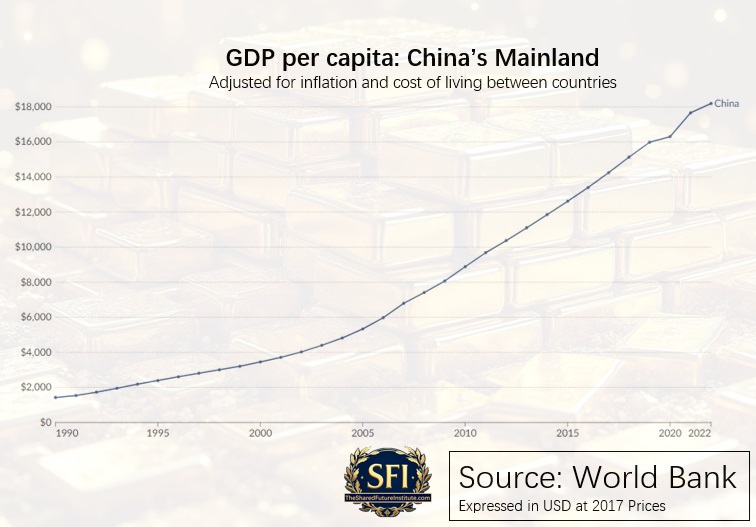
The word ‘slowing’ has come to dominate Western media headlines and arguments about the nature of China’s economic growth and outlook. But what is meant by slowing, and what is the purpose in re-using this word so repeatedly?
On October 18th, 2024, the BBC ran an article entitled “China’s Economic Slowdown Deepens.” The primary argument for the use of the word ‘slowing’ in the media is the reduction in the percentage of China’s GDP increase each year verses what it was 5 or ten years ago. But what this analysis ignores is that China is adding a trillion dollars to its economy a year, the same as for the past several years. This is a graduation towards the mean, and that is all. China’s new gross domestic product additions in real terms are not slowing, but continuing at the same or higher rates as they were in previous years.
Another critical element this is missing is China’s self-expressed goals. in 2020, Chinese officials expressed the desire to have an average of 4.7% GDP growth over the years from 2020 to 2035. The math demonstrates this would lead to a doubling of China’s total GDP. Given China’s GDP growth rate in 2023 was 5.2% and is set to be about 5% for 2024, China is likely to achieve its own goal.
And if we compare China’s economic growth with that of the United States, a nation of similar economic size, we see China outstripping that of the US regularly. Again in 2023, China’s GDP grew by 5.2% whereas that of the US grew by 2.5%. The economy of China grew by more than twice that of the US. Some like to say that the US economy grows slower because of its size. Western media still regularly call China’s economy, the world’s second largest economy. Bloomberg published an article on November 29th entitled “French Inflation Up Less than Expected on Weaker Economy” in which their writes referred to China’s economy as the “world’s second largest economy.’ But this is either by choice or ignorance. And Bloomberg is hardly the only one to use terminology to seemingly deliberately reduce the importance and success of China’s economy.
So, what makes China’s economy something other than the world second largest? As measured by purchasing power parity, or PPP, China’s economy become the world’s largest in 2015. The US is, in fact, the world’s second largest economy. As of 2024, the United States has an estimated GDP (purchasing power parity) of approximately $29.17 trillion, while mainland China, including Hong Kong, has a combined GDP (PPP) of about $37.61 trillion. This includes $37.07 trillion from mainland China and $538.7 billion from Hong Kong. These figures reflect China’s position as the world’s largest economy by PPP, far surpassing that of the United States.
So is China’s economy ‘slowing?’ No. China’s economy will be twice the size of the United States in nominal terms by 2035. Moreover, China may someday be as large as three times that of the United States in nominal terms. Facts matter. Its time we understand the world as it really is. Pretending isn’t good for anyone.


 The Shared Future Institute
Leave a comment