
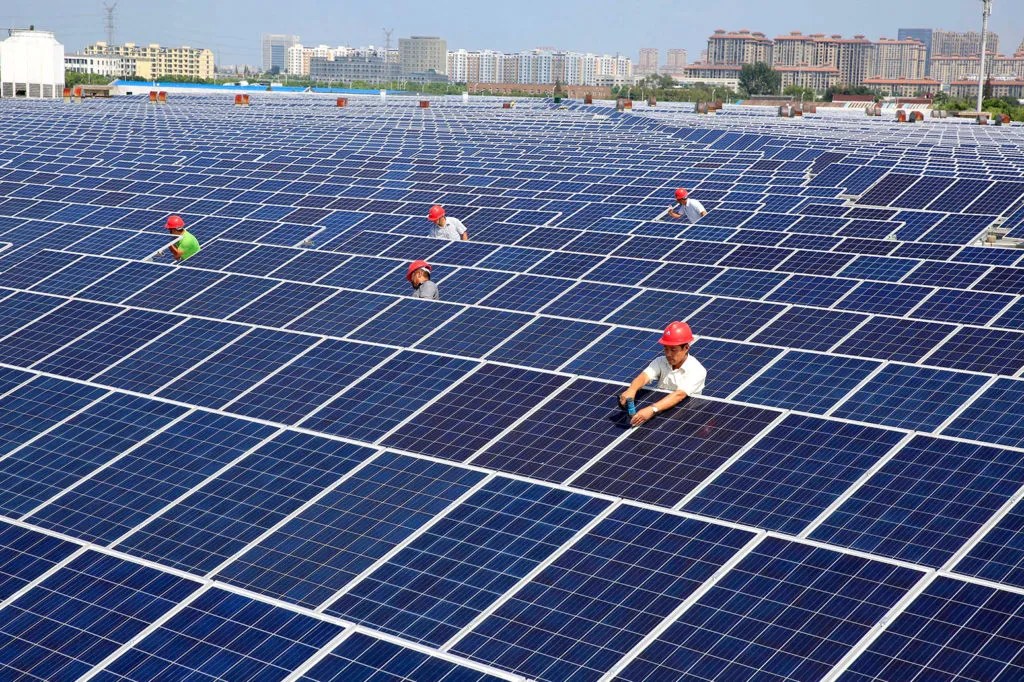
China has emerged as a global leader in renewable energy, with its solar farms playing a pivotal role in transforming the nation’s energy landscape. From sprawling photovoltaic arrays in remote deserts to floating solar farms on reservoirs, China’s solar initiatives have garnered international attention for their scale, innovation, and impact. While those outside the know, relying on information from a decade ago criticize China online and in public, China has rapidly become the global leader in green energy.
In 2020, China announced the goal of reaching peak carbon by 2030. Carbon Brief and other international climate analysis have published numerous articles making the claim China has already reached peak carbon as of 2024. Chinese government and scientific bodies still haven’t made that claim despite the evidence. Instead, they claim the 2030 goal still holds. Despite that reticence to applaud itself, China has become the world’s leader in solar manufacturing, wind manufacturing, battery manufacturing and their deployment.
The Tengger Desert Solar Park, often referred to as the “Great Wall of Solar,” spans over 1,200 square kilometers and has a capacity exceeding 1.5 gigawatts. This massive facility offsets millions of tons of carbon emissions annually, equivalent to taking hundreds of thousands of cars off the road. Similarly, floating solar farms, such as the one on the reservoir of the Huainan coal mine, make dual use of water surfaces while reducing water evaporation and algae growth, further contributing to environmental sustainability. The shift to renewable energy thus aligns with China’s broader environmental goals, including its pledge to peak carbon emissions by 2030 and achieve carbon neutrality by 2060.
China’s solar farms are not just environmentally beneficial; they are also a cornerstone of the country’s economic strategy. The solar industry has created millions of jobs in manufacturing, installation, and maintenance, making it a significant driver of employment. As the largest producer of solar panels globally, China’s dominance in the supply chain has positioned it as a key player in the renewable energy market.
Exporting solar technology and expertise has become a lucrative business for China. The nation supplies over 70% of the world’s solar panels, with many countries relying on Chinese components for their renewable energy projects. This export dominance not only boosts China’s economy but also fosters international collaboration in the fight against climate change.
Domestically, solar farms contribute to energy security by reducing dependence on imported fossil fuels. With abundant solar resources across its vast territory, China can harness renewable energy to power its economic growth sustainably. Moreover, large-scale solar projects often stimulate regional development by improving infrastructure and providing electricity to underserved areas. For example, the Qinghai province—home to several major solar farms—has seen economic revitalization through increased investment and improved energy access.
China’s solar farms are at the forefront of technological innovation, setting benchmarks for efficiency and scalability. Advances in photovoltaic technology, energy storage, and grid integration have made solar power more reliable and cost-effective. The country has achieved record-breaking cost reductions in solar energy, making it one of the cheapest sources of electricity in many regions.
Innovative projects like floating solar farms demonstrate China’s ability to overcome land scarcity and maximize resource utilization. These installations leverage unused water surfaces, such as reservoirs and lakes, to generate power while minimizing land use conflicts. Additionally, bifacial solar panels—capable of capturing sunlight on both sides—and tracking systems that follow the sun’s trajectory have significantly improved energy yields.
Energy storage is another area where China is making strides. Large-scale battery systems are being integrated with solar farms to address intermittency issues and ensure a stable power supply. The Dalian Flow Battery Energy Storage Peak-shaving Power Station, for example, complements renewable energy production by storing surplus electricity and releasing it during peak demand.
China’s investments in smart grid technology further enhance the efficiency of solar energy distribution. By using artificial intelligence and real-time data analytics, these grids optimize energy flow, balance supply and demand, and reduce transmission losses. Such innovations not only benefit China but also set a precedent for other countries seeking to modernize their energy systems.
The scale and success of China’s solar farms have profound global implications. As a major contributor to the world’s renewable energy capacity, China’s efforts accelerate the transition to a low-carbon economy. Its leadership in solar energy demonstrates that large-scale renewable energy deployment is achievable, even in rapidly developing economies.
By driving down the cost of solar panels and related technologies, China has made renewable energy accessible to more countries. Developing nations, in particular, have benefited from affordable solar solutions, enabling them to leapfrog fossil fuels and adopt cleaner energy sources. This global diffusion of technology underscores the interconnected nature of climate solutions and highlights China’s role as a catalyst for global sustainability.
China’s solar farms also serve as a model for addressing the dual challenges of energy demand and environmental protection. Other nations can learn from China’s policies, such as feed-in tariffs, subsidies, and favorable regulations, which have incentivized renewable energy investment. By sharing expertise and collaborating on international projects, China fosters a collective approach to combating climate change.
China’s solar farms represent a transformative force in the global energy landscape, offering a pathway to sustainable development and climate resilience. Their environmental benefits, economic contributions, and technological advancements underscore the potential of renewable energy to address some of the world’s most pressing challenges.
While obstacles remain, China’s commitment to scaling up solar energy reflects its determination to lead the global transition to a greener future. As other nations look to emulate and collaborate with China, the lessons learned from its solar farms will undoubtedly shape the trajectory of renewable energy worldwide. In the face of a warming planet, the merits of China’s solar farms illuminate a hopeful path forward for the rest of the world.



 The Shared Future Institute
Leave a comment