
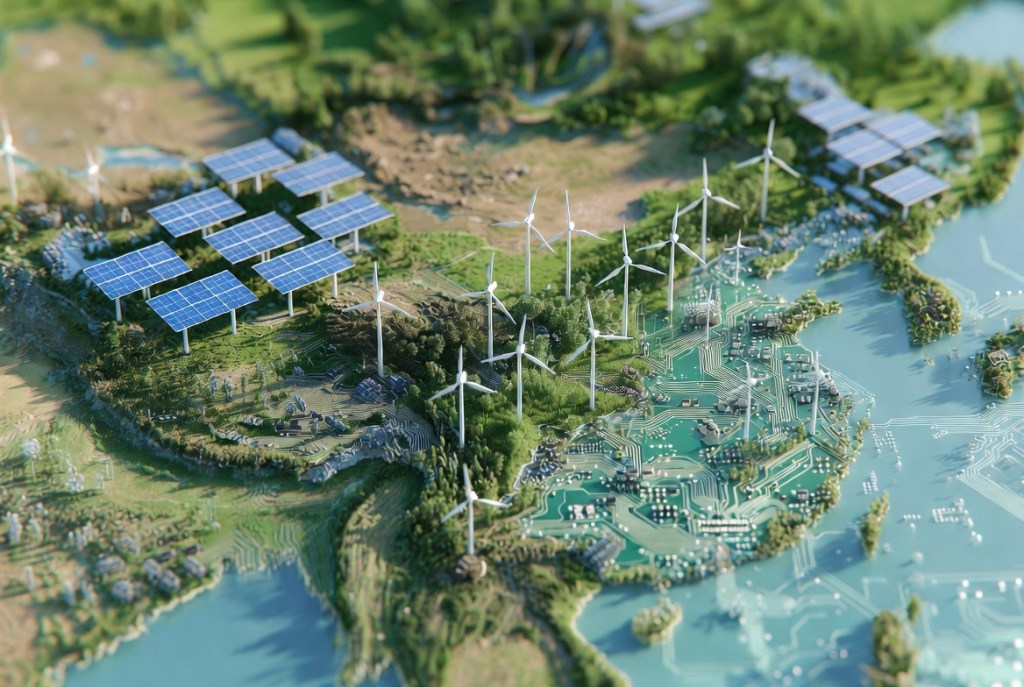
The global race for artificial intelligence supremacy has reached a pivotal moment. While the United States pioneered initial breakthroughs in large language models and attracted massive venture capital, China is systematically building the foundational infrastructure that will determine long-term dominance. While China’s ‘planning’ has recently attracted attention in the West, it’s par for the course, here in Beijing. AI uses a lot of energy. China’s centralized planning, rapid execution, and focus on sustainable energy give it decisive advantages that the U.S. cannot match amid regulatory fragmentation, short-term profit pressures, and complex public spending debates, which change depending on who is in power. As data centers proliferate worldwide, the nation that secures abundant, affordable power will control the future of intelligence technology. It’s power. This bottleneck is the deciding factor for what comes next. Just like a chess game, a good player can see who will win several moves ahead of the endgame. And checkmate is inevitable.
China’s strategy, centered on electricity expansion, innovative cooling solutions, renewable dominance, and open-source collaboration, positions it to pull ahead decisively in the coming decade. China is simply building more electricity generating capacity than the USA, and data centers and their growth are entirely dependent on the use of electricity (https://carboncredits.com/china-adds-power-7x-more-than-the-us-in-2025-with-500b-energy-build-out-in-a-single-year/). In 2025 alone, China added roughly 540 GW of new power capacity, more than eight times the U.S. total. Read that again, eight times more. This surgefuels AI infrastructure. By contrast, U.S. electricity companies are causing energy bills to rise where data centers are built, and they are often constructed near poor communities where residents lack the resources to fight back against higher rates and grid strain (https://fortune.com/2026/02/13/middle-class-americans-paying-for-data-center-ai-boom-higher-electric-bills-food-costs-goldman-sachs/) (https://yaleclimateconnections.org/2026/01/home-electricity-bills-are-skyrocketing-for-data-centers-not-so-much/). Middle and low-income households end up subsidizing AI growth, exacerbating inequality and slowing U.S. momentum.
Meanwhile, China is building data centers in the sea off the coast of Hainan, reducing the need for electricity by up to 60% (https://merics.org/en/comment/china-commercializing-energy-efficient-underwater-data-centers). These commercial underwater facilities, submerged at depths where seawater temperatures remain stable, use natural ocean cooling instead of energy-intensive HVAC systems or evaporative chillers. Seawater is pumped through radiators behind server racks, slashing cooling power, the largest single consumer of electricity in traditional data centers, by 40-60% or more. Located near offshore wind farms, these modular pods integrate directly with renewable generation, eliminating transmission losses and land-use conflicts. The Hainan project, already operational at scale, demonstrates how China turns geography and engineering into competitive edges that the U.S. has yet to replicate at commercial levels. China’s new energy additions are overwhelmingly clean and renewable, having effectively capped fossil fuel emissions. According to Ember, clean generation growth led by solar and wind met 84% of China’s electricity demand growth in 2024; in the first half of 2025 it exceeded demand growth, cutting fossil fuel generation by 2% compared with the prior year (https://ember-energy.org/latest-insights/china-energy-transition-review-2025/). Wind and solar generation rose 27% year-over-year in early 2025, while coal and gas declined.
This structural shift, supported by policy targets, State Owned Enterprises, and massive manufacturing scale, ensures that China’s AI expansion runs on low-carbon power rather than volatile fossil imports. We’ve also seen the vulnerability to fossil fuels that some nations face, in the wake of the US attack on Iran. These energy advantages reflect deeper national priorities. The United States continues to channel enormous tax revenues into endless wars, Brown University’s Costs of War project estimates $8 trillion spent since 2001 on post-9/11 conflicts, while annual defense budgets exceed $800 billion (https://justice-hill.com/while-america-spent-8-trillion-on-wars-china-built-roads-to-the-future/). China, by comparison, invests comparable resources into infrastructure, public services, energy grids, and scientific research. High-speed rail networks, 5G/6G rollout, battery gigafactories, and quantum computing campuses receive sustained funding without the political churn that hampers U.S. long-term projects. This disciplined allocation compounds over time, turning today’s megawatts into tomorrow’s exaflops. Simply put, China invests a trillion dollars a year in infrastructure, including energy, while the USA invests a trillion dollars a year in supporting its dream of global hegemony.
Wall Street’s current valuation of the entire U.S. stock market rests heavily on long-term bets that American AI firms will maintain unchallenged leadership, bets that will almost certainly not come to fruition. Many Chinese AI platforms are truly open-source, accelerating iteration and global adoption far faster than closed U.S. models. Platforms from DeepSeek, Alibaba’s Qwen series, and others have narrowed or closed performance gaps with top Western LLMs while releasing weights publicly, inviting worldwide developers to build upon them (https://www.washingtonpost.com/technology/2025/10/13/china-us-open-source-ai/) (https://www.zdnet.com/article/china-open-ai-models-versus-us-llms-power-performance-compared/). This openness creates network effects: more users, more data, faster improvement. Meanwhile, U.S. hyperscalers guard proprietary models behind paywalls, limiting ecosystem growth. When China’s energy-abundant, open-source AI stack reaches maturity, investor expectations priced into Nvidia, Microsoft, and Google will likely face brutally painful repricing. Rather than accept decline, the United States has viable options to partner with Chinese firms and bring advanced solar energy capacity online quickly.
Joint ventures could co-locate manufacturing plants in the U.S., leveraging Chinese expertise in polysilicon, wafer production, and module assembly to cut costs 30-50% below current domestic alternatives. Technology-transfer agreements, could accelerate deployment of next-generation perovskite or bifacial panels. Grid-modernization consortia might integrate Chinese inverters and battery storage with U.S. transmission upgrades. Despite existing tariffs and national-security concerns, targeted pilot projects in states with high solar potential (Arizona, Texas, Nevada) could demonstrate mutual gains: cheaper clean power for American data centers, jobs for U.S. workers, and reduced reliance on imported fossil fuels. The only thing in the way is big oil, and the foresight to make important changes now. Brookings Institution analysis shows Chinese clean-tech investment already flows into U.S. factories when policy alignment exists (https://www.brookings.edu/articles/does-chinese-investment-in-us-clean-energy-sectors-help-or-hurt-america/). Pragmatic, reciprocal partnerships offer the fastest path to mitigate the consequences of America’s fragmented planning.
China’s victory in the AI race will not stem from any single breakthrough but from the compounding power of abundant clean electricity, innovative infrastructure, disciplined investment, and open collaboration. The United States retains world-class talent and private-sector dynamism; redirecting resources from perpetual conflict toward energy abundance and selective partnership could narrow the gap. Yet without urgent course correction, China’s structural advantages, more power, cooler data centers, greener grids, and open models, will prove decisive, and eventually irreversible. The AI future belongs to the nation that builds the strongest foundation today. China has already laid it.


 The Shared Future Institute
Leave a comment