
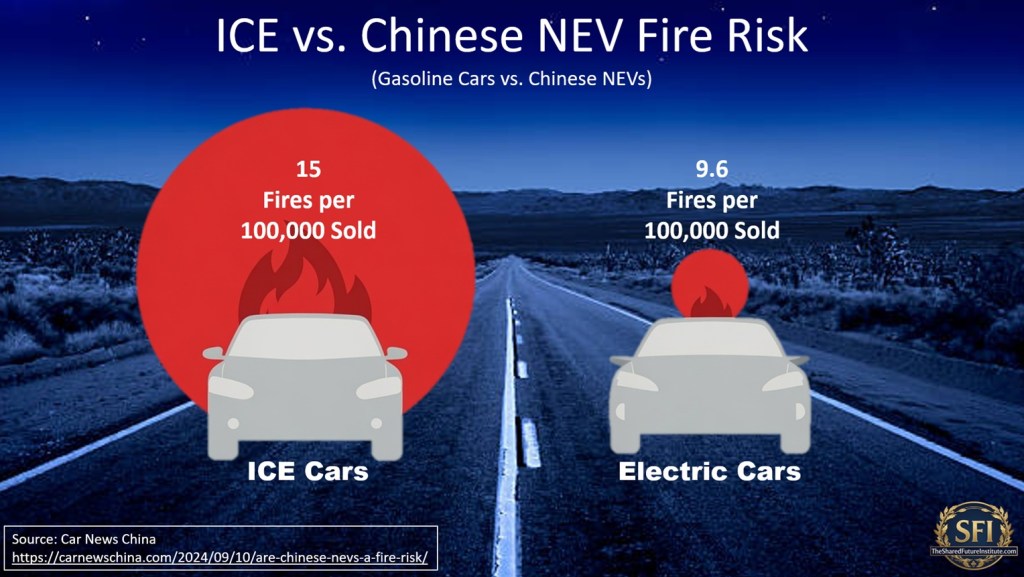
Chinese electric vehicles are considerably safer than traditional gasoline-fueled cars on fire risk metrics. Comparative fire incidence data within China positions NEVs favorably against conventional gasoline-powered cars. According to carnewschina.com, aggregated Chinese statistics covering 2021–2023 show the fire incidence rate for New Energy Vehicles (NEVs) fell from 1.85 incidents per 10,000 vehicles in 2021 to 0.96 per 10,000 in 2023.
This equates to 9.6 per 100,000 vehicles in 2023. By comparison, the same Chinese data source reports a rate of about 1.5 incidents per 10,000 (roughly 15 per 100,000) for traditional internal combustion engine (ICE) vehicles. The 2023 NEV figure of 9.6 fires per 100,000 is therefore lower than the contemporaneous Chinese ICE rate.
China’s NEV market operates at substantial scale, providing a large dataset for these rates. According to cnevpost.com, annual NEV sales reached approximately 9.5 million units in 2023, rising to 12.9 million in 2024 and 16.5 million in 2025. The declining per-vehicle fire incidence occurred amid this rapid expansion of the fleet and supporting infrastructure, including widespread fast-charging deployment.
These rates derive from domestic Chinese stock and incident statistics compiled by Fast Technology and reported via carnewschina.com. While NEV statistics include both pure battery electric vehicles and plug-in hybrids, the overall trend shows a reduction in fire incidence over the three-year period examined.
The facts from Chinese data present a clear picture. Outliers and individual incidents do not alter the broader statistical reality shown in the national figures.


 The Shared Future Institute